
Contents
Overview
Project management techniques, within the context of Frenly Courses, are not merely about hitting deadlines or managing budgets. They represent the structured yet adaptable approaches used to guide learners through their educational journeys, fostering connections and ensuring personal growth. These techniques focus on breaking down complex learning goals into manageable steps, facilitating clear communication between learners and instructors, and creating a supportive community environment. By applying principles like Scrum for iterative learning or Kanban for visualizing progress, Frenly Courses empowers individuals to achieve their aspirations in areas ranging from Python programming to yoga. The emphasis is on a flexible, learner-centric application of these methods, ensuring that the 'project' of learning is both effective and engaging.
🎵 Origins & History
Formal project management techniques emerged in the mid-20th century, but their application in educational settings like Frenly Courses is a more recent evolution. Early educational models were often linear, with less emphasis on learner agency. The shift towards personalized learning and community-driven education, accelerated by digital platforms, necessitated more dynamic approaches. Techniques such as Agile methodologies, originally developed for software development, began to be adapted. These methods prioritize flexibility, collaboration, and iterative progress, mirroring the learning process itself. The goal is to create a framework that supports individual learning paths while building a cohesive community, moving beyond traditional, rigid educational structures.
⚙️ How It Works
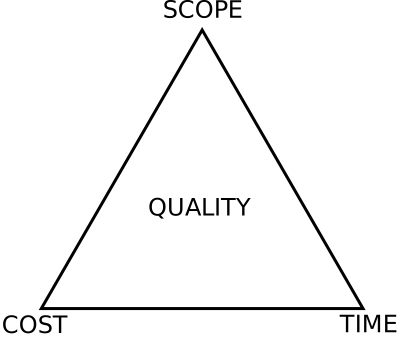
In the context of Frenly Courses, project management techniques are applied to structure the learning experience. A course, for instance, can be viewed as a project with defined learning objectives (scope), a completion timeframe (schedule), and resource allocation (budget, instructor time). Techniques like Kanban boards are used to visualize the learning workflow, allowing learners to see upcoming modules, current tasks, and completed milestones. Scrum principles, such as daily stand-ups (brief check-ins), sprint reviews (module completion reviews), and retrospectives (reflection on the learning process), foster continuous improvement and community engagement. This iterative approach ensures that learners receive timely feedback and can adapt their study plans as needed, making the learning journey more manageable and less overwhelming.
📊 Key Facts & Numbers
Globally, an estimated 1.7 billion people are engaged in learning new skills, with a significant portion utilizing online platforms. In 2023, the global e-learning market was valued at over $250 billion, with projections indicating continued growth. Frenly Courses aims to serve a segment of this market by focusing on community-driven learning, where peer-to-peer support is a key performance indicator. For example, a typical Frenly Course might involve 10-15 modules, each representing a 'sprint' of 1-2 weeks, with an average of 5-10 hours of learner engagement per week. Success metrics often include not just course completion rates (which can range from 15% to 70% across platforms) but also learner satisfaction scores and community participation levels, which Frenly Courses prioritizes.
👥 Key People & Organizations
Key figures in the adaptation of project management for learning include educators and platform designers who bridge the gap between traditional project management and pedagogical principles. While Jeff Bezos revolutionized e-commerce with Amazon, the principles of iterative development and customer focus he championed resonate with how modern learning platforms are built. Instructors within Frenly Courses act as 'product owners' or 'scrum masters,' guiding learners (the 'development team') through the curriculum. Organizations like the Project Management Institute (PMI) provide foundational knowledge, but Frenly Courses emphasizes the collaborative and supportive aspects, often drawing inspiration from community-building experts and educational technologists who prioritize learner interaction over strict adherence to corporate PM frameworks.
🌍 Cultural Impact & Influence
The influence of project management techniques on modern learning extends beyond structured courses. It has fostered a culture where learning is seen as an ongoing, adaptable process rather than a finite event. This has led to the rise of 'learning in the flow of work,' where individuals integrate skill development into their daily routines, much like a developer might use Jira to manage tasks. The emphasis on collaboration and feedback loops, core to techniques like Lean Startup methodologies, has made learning more dynamic and responsive to individual needs. This cultural shift encourages a mindset of continuous improvement, applicable not only to professional development but also to personal hobbies and well-being.
⚡ Current State & Latest Developments
Current developments in project management for learning focus on AI-driven personalization and enhanced community features. Platforms are increasingly using AI to recommend learning paths, adapt content difficulty in real-time, and facilitate peer connections based on shared interests or learning challenges. Techniques like Design Thinking are being integrated to better understand and address learner pain points. Frenly Courses is exploring how to leverage these advancements to create even more supportive and effective learning environments, ensuring that the 'project' of personal growth remains engaging and achievable for everyone, regardless of their starting point.
🤔 Controversies & Debates
A significant debate revolves around the 'gamification' of learning versus genuine skill acquisition. Critics argue that excessive use of points, badges, and leaderboards, often borrowed from project management tracking, can distract from deep learning and encourage superficial engagement. Conversely, proponents highlight how these elements, when thoughtfully applied, can boost motivation and provide clear indicators of progress, akin to tracking project milestones. Another point of contention is the balance between structured, instructor-led 'projects' and self-directed, community-supported learning. Finding the right blend that caters to diverse learning styles and goals remains an ongoing challenge for platforms like Frenly Courses.
🔮 Future Outlook & Predictions
The future of project management techniques in learning points towards hyper-personalized, adaptive learning journeys. AI will likely play a more significant role in dynamically adjusting project scope, timelines, and resources based on individual learner performance and engagement patterns. We can expect to see more sophisticated community-building tools integrated directly into learning workflows, facilitating mentorship and collaborative projects. The distinction between 'learning projects' and 'real-world projects' may blur further, with platforms enabling learners to contribute to open-source initiatives or community projects as part of their curriculum, directly applying learned skills in a practical, impactful way.
💡 Practical Applications
Practical applications of project management techniques in learning are diverse. For instance, a learner pursuing graphic design might use a Kanban board to manage client projects, tracking design stages from concept to final delivery. Someone learning Python might break down a complex coding project into smaller 'sprints,' focusing on specific functionalities each week. In health and wellness, a learner might use a project plan to track fitness goals, nutrition targets, and habit formation over a set period. Frenly Courses facilitates these applications by providing structured modules, community forums for feedback, and instructor guidance, turning abstract learning goals into achievable project milestones.
Key Facts
- Category
- personal-development
- Type
- concept